

BPC-157: A Comprehensive Guide for Scientific Research in Australia
- peptideresearchau
- Feb 18
- 12 min read
Updated: Mar 1
In the field of peptide research, distinguishing scientific fact from unsubstantiated claims is critical. For Australian researchers investigating the potential of BPC-157, this challenge is compounded by questions surrounding compound purity, regulatory navigation, and correct laboratory protocols. The lack of reliable, non-sensationalized information can impede progress and introduce uncertainty into meticulously planned studies. This guide provides the clarity required to advance your work with confidence.
The principles of cytoprotection and mucosal healing explored in BPC-157 research share conceptual parallels with other areas of gut health science, including veterinary applications. For instance, the development of targeted probiotics for companion animals represents a different but related approach to maintaining digestive integrity. Researchers interested in such commercially developed products can find out more about Purrlys Cat Dental Probiotic - 30g.
We offer a comprehensive scientific overview of the BPC-157 peptide, tailored specifically for laboratory research in Australia. This article will detail its molecular structure, explore its evidence-based mechanisms of action observed in preclinical studies, and provide essential guidance on sourcing high-purity compounds. Furthermore, we will outline the proper handling and preparation procedures necessary to ensure the integrity of your research, equipping you with the foundational knowledge to inform your next study.
Key Takeaways
Understand the scientific basis of BPC-157, from its origin as a gastric peptide sequence to its complex mechanisms of action observed in preclinical models.
Discover the primary fields of preclinical study for bpc 157, providing a framework to inform the design of your own laboratory investigations.
Differentiate between the stable arginate salt and standard acetate forms to select the appropriate compound for your specific experimental design.
Learn the critical criteria for sourcing high-purity, research-grade peptides in Australia to ensure the accuracy and reliability of your study data.
Table of Contents What is BPC-157? A Scientific Introduction Mechanism of Action: How BPC-157 Works in Research Models Key Areas of BPC-157 Research: A Review of Preclinical Studies Forms of BPC-157 for Laboratory Use: Stable vs. Arginate Salt Handling and Protocol for BPC-157 Research Sourcing High-Purity BPC-157 in Australia for Research
What is BPC-157? A Scientific Introduction
BPC-157 is a synthetic pentadecapeptide, a sequence of 15 amino acids derived from a protein naturally occurring in human gastric juice. This protein was originally termed Body Protection Compound, from which the peptide gets its name. First isolated and characterized in the 1990s, the bpc 157 compound has become a subject of extensive preclinical research due to its observed cytoprotective and regenerative activities in various tissue models. For a foundational overview, researchers can consult this comprehensive BPC-157 Introduction. It is imperative for Australian researchers to understand that BPC-157 is strictly a research-grade compound. It is not approved for human therapeutic use by the Therapeutic Goods Administration (TGA) and is intended for laboratory research purposes only.
Chemical Structure and Properties
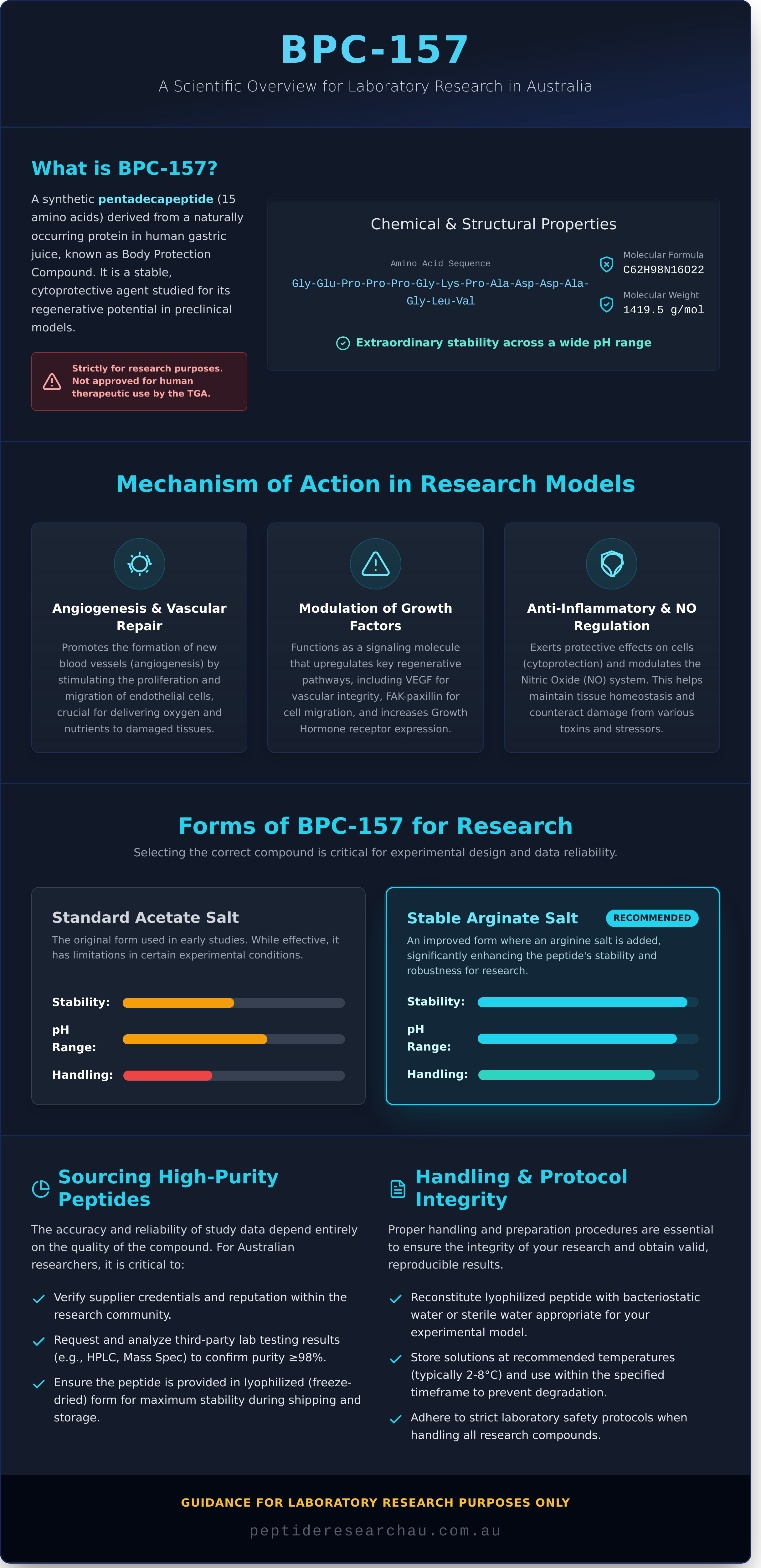
The primary structure of BPC-157 consists of the specific amino acid sequence: Gly-Glu-Pro-Pro-Pro-Gly-Lys-Pro-Ala-Asp-Asp-Ala-Gly-Leu-Val. This precise arrangement is fundamental to its biological function and stability. Its key molecular characteristics are:
Molecular Formula: C62H98N16O22
Molecular Weight: 1419.5 g/mol
A defining feature of this peptide is its extraordinary stability across a wide pH range, particularly in the highly acidic environment of gastric juice. Unlike many peptides that degrade quickly, BPC-157 maintains its structural integrity. This resilience makes it a robust compound for in-vitro and in-vivo studies, as it can be administered through various routes in animal models without significant degradation, ensuring consistent experimental conditions.
The 'Body Protection Compound' Designation
The name "Body Protection Compound" directly reflects the initial focus of its scientific investigation. Early studies concentrated on its potent protective effects within the gastrointestinal system of animal models. Researchers observed its capacity to maintain GI mucosal integrity and counteract damage from various ulcerogens, NSAIDs, and other toxins. This foundational research established the peptide's role as a potent cytoprotective agent. It is crucial to distinguish this peptide from other classes of biological molecules. It is not a hormone, steroid, or growth factor; rather, it is a stable gastric pentadecapeptide with a unique signaling pathway that appears to modulate other systems, including the nitric oxide (NO) system, to exert its effects.
Mechanism of Action: How BPC-157 Works in Research Models
The therapeutic potential of BPC-157 observed in preclinical studies stems from its complex and multi-faceted mechanism of action. It is crucial for Australian researchers to understand that all current knowledge is derived from in vitro (cell culture) and animal models. This peptide is not a direct structural repair agent; instead, it functions as a potent signaling molecule that orchestrates the body's innate repair processes. Its primary role appears to be cytoprotective, meaning it protects cells from various forms of damage. Due to these potent biological effects, its Regulatory Status of BPC-157 remains strictly for research purposes, and it is not approved for human therapeutic use.
Angiogenesis and Vascular Repair
One of the most well-documented effects of bpc 157 is its pro-angiogenic activity. Angiogenesis is the physiological process through which new blood vessels form from pre-existing vessels. In research models, the peptide has been shown to stimulate the proliferation and migration of endothelial cells, which are the primary cells lining blood vessels. This action is critical for delivering oxygen and nutrients to damaged tissue, a fundamental step in healing wounds, tendons, and ligaments.
Modulation of Growth Factor Pathways
BPC-157 exerts significant influence over key growth factor pathways essential for tissue regeneration. Laboratory studies indicate that it can:
Interact with VEGF: It upregulates the Vascular Endothelial Growth Factor (VEGF) pathway, which is a master regulator of angiogenesis and vascular integrity.
Activate FAK-Paxillin Pathway: This peptide has been observed to activate the Focal Adhesion Kinase (FAK)-paxillin pathway, which is vital for cell adhesion and migration, allowing repair cells to move into an injury site.
Influence GH Receptors: In studies on tendon fibroblasts, BPC-157 was found to increase the expression of growth hormone (GH) receptors, potentially sensitising tissues to the body's own anabolic signals.
Anti-Inflammatory and Nitric Oxide Regulation
While inflammation is a necessary part of healing, excessive or prolonged inflammation can impede recovery. BPC-157 has demonstrated an ability to modulate the inflammatory response in animal models, often reducing pro-inflammatory markers. Furthermore, it interacts closely with the nitric oxide (NO) system. By modulating NO synthesis, it can help regulate blood flow, protect the endothelial lining, and counteract damage in gastrointestinal models, such as those mimicking inflammatory bowel disease or gastric ulcers.
Key Areas of BPC-157 Research: A Review of Preclinical Studies
The synthetic peptide bpc 157 has become a subject of intense scientific interest due to its potential cytoprotective and regenerative properties observed in laboratory settings. It is crucial to underscore that the following data is derived exclusively from preclinical, non-human studies. These findings represent promising avenues for future inquiry, not established therapeutic benefits in humans. The research can be broadly categorized into three primary domains.
Gastrointestinal and Gut Health Research
A significant body of research has focused on the gastrointestinal tract. In animal models of inflammatory bowel disease (IBD), BPC-157 has been investigated for its potential to mitigate inflammation and promote mucosal healing. Further studies indicate it may accelerate the healing of gastric ulcers in rodents, potentially by protecting the endothelial tissue that lines blood vessels. This has led researchers to explore its role in maintaining the integrity of the intestinal lining against various chemical and physical insults in controlled laboratory environments.
Musculoskeletal and Soft Tissue Studies
Perhaps the most extensive research into BPC-157 involves its effects on musculoskeletal tissues. Preclinical studies suggest it may positively influence the healing of damaged tendons, ligaments, and skeletal muscle. In models involving tendon-to-bone healing, administration of the peptide was observed to improve functional recovery. Mechanistically, research points towards its ability to stimulate fibroblast outgrowth from tendon explants, a critical step in the formation of new connective tissue. These findings form the basis for its continued investigation in soft tissue repair.
Neurological and Organ Protection Research
Emerging research explores the compound's potential neuroprotective effects. Preclinical studies in rodent models of traumatic brain injury and nerve damage suggest BPC-157 may support neuronal survival and regeneration. Beyond the nervous system, its organo-protective properties are being examined. For instance, some laboratory models indicate it could counteract drug-induced damage to organs like the liver and pancreas. The mechanisms are complex, with a comprehensive BPC-157 Research Review from the NCBI detailing various potential cellular pathways that warrant further scientific exploration.
Forms of BPC-157 for Laboratory Use: Stable vs. Arginate Salt
When acquiring BPC-157 for research purposes in Australia, it is critical to understand the two primary forms available: the standard acetate salt and the more stable arginate salt. The selection between these two variants is not arbitrary; it directly impacts experimental design, administration routes, and the validity of research outcomes. Each form possesses distinct properties tailored for different laboratory applications.
Standard BPC-157 (Acetate Salt)
The standard form of BPC-157 is an acetate salt. Historically, this is the most widely studied variant, and it features prominently in the foundational scientific literature. It is typically used in research protocols involving subcutaneous or intramuscular injection after being reconstituted with bacteriostatic water. Its primary limitation is its relatively low stability in solution, requiring prompt use after preparation to prevent degradation and ensure accurate dosing.
BPC-157 Arginate Salt
BPC-157 Arginate Salt is a newer, chemically enhanced formulation. By adding an L-Arginine salt to the peptide chain, its stability in liquid form is significantly improved. This key modification makes it highly resistant to degradation, particularly in the acidic conditions of gastric juice. Consequently, the arginate form is the superior choice for studies involving oral administration in animal models, allowing for targeted research on the gastrointestinal tract.
Choosing the Right Form for Your Study
The optimal form of bpc 157 for your laboratory depends entirely on your research objectives. For studies investigating systemic effects via injection, the standard acetate salt is a well-documented and effective option. However, for protocols focused on gastrointestinal healing or requiring oral administration, the enhanced stability of the arginate salt is indispensable. The summary below provides a direct comparison to guide your selection.
Stability: Acetate (Low in solution) vs. Arginate (High in solution and gastric acid)
Primary Administration Route: Acetate (Injectable) vs. Arginate (Oral, Injectable)
Common Research Focus: Acetate (Systemic tissue repair) vs. Arginate (Gastrointestinal tract, oral delivery studies)
Careful consideration of these factors ensures the integrity and reproducibility of your experimental results. View our high-purity BPC-157 options for your research.
Handling and Protocol for BPC-157 Research
The validity of any scientific study depends on meticulous laboratory protocol. When working with research-grade peptides, proper handling, storage, and reconstitution are paramount to ensure the compound's stability and the reliability of experimental results. The following guidelines are provided for informational purposes for qualified Australian researchers in a controlled laboratory setting. Adhering to these steps helps preserve the integrity of the bpc 157 compound throughout your study.
Storage of Lyophilized Peptide
Lyophilized (freeze-dried) BPC-157 is stable but requires specific conditions to maintain its integrity long-term. For optimal preservation, the vial should be stored in a freezer at approximately -20°C. It is also critical to protect the powder from direct light and moisture, as these elements can degrade the delicate peptide structure over time. Always keep the vial sealed in a dark, dry place until it is ready for reconstitution.
Reconstitution Procedure
Reconstitution is the process of dissolving the lyophilized peptide powder in a suitable sterile diluent. Bacteriostatic water is the standard diluent for this purpose, as it contains 0.9% benzyl alcohol to inhibit bacterial growth and maintain sterility. Follow these steps carefully:
Preparation: Allow the vial of BPC-157 to reach room temperature before opening to prevent condensation. Assemble your supplies, including the peptide vial, bacteriostatic water, and a sterile syringe for measurement.
Dilution: Using the sterile syringe, draw the calculated volume of bacteriostatic water. Slowly inject the water into the peptide vial, angling the needle so the liquid runs down the side of the glass wall. This minimises agitation.
Dissolving: Do not shake the vial. Vigorous shaking can damage the peptide's molecular structure. Instead, gently roll the vial between your fingers or swirl it carefully until the powder is fully dissolved into a clear solution.
Storage of Reconstituted Solution
Once reconstituted, the liquid bpc 157 solution is significantly less stable and must be handled accordingly. The solution must be stored in a refrigerator at 2-8°C at all times. When stored correctly and sterile techniques are maintained during each use, the solution typically remains viable for research applications for up to four weeks. Consistently using sterile procedures is essential to prevent contamination and preserve the compound's efficacy for the duration of your study.
Sourcing High-Purity BPC-157 in Australia for Research
For any scientific investigation, the quality of the materials used is fundamental to the integrity of the results. When sourcing compounds like bpc 157 for laboratory use, purity is not a preference-it is a prerequisite for valid and reproducible data. Contaminants or incorrectly synthesised peptides can compromise an entire study, leading to inaccurate conclusions. Therefore, selecting a reputable supplier is a critical step in the research process.
The Importance of Third-Party Testing
A supplier's claim of quality must be substantiated by objective, independent analysis. Researchers should demand a Certificate of Analysis (COA) for each batch, which typically includes two key tests. High-Performance Liquid Chromatography (HPLC) determines the purity of the peptide, ideally showing a concentration of 98% or higher. Mass Spectrometry (MS) verifies that the peptide has the correct molecular weight and chemical structure, confirming its identity.
Why Choose an Australian Supplier?
Opting for a domestic Australian supplier offers significant logistical and quality assurance advantages. Researchers benefit from faster shipping times, eliminating the risk of lengthy delays or seizures at customs that can occur with international shipments. Furthermore, a local company provides accessible customer support and operates under Australian consumer and business laws, ensuring a higher degree of accountability and adherence to recognised quality standards.
Researcher's Checklist for Sourcing Peptides
Before purchasing any research peptide, use this checklist to evaluate the supplier:
Third-Party COA: Does the supplier provide a recent, batch-specific Certificate of Analysis detailing HPLC and MS results?
Australian Base: Is the company registered and based in Australia, with a verifiable physical address and clear contact details?
Professionalism: Does the website present clear, accurate product information and maintain a professional standard?
Regulatory Compliance: Is there a clear disclaimer stating that products are intended strictly for research purposes only?
Diligence in sourcing is paramount for credible research. For investigators seeking laboratory-grade compounds that meet these rigorous criteria, Peptide Research AU provides a trusted domestic source committed to quality and transparency.
Advancing Research with BPC-157 in Australia
The body of preclinical evidence highlights the significant potential of the peptide bpc 157 across various research models. As we have explored, its complex mechanism of action presents numerous avenues for scientific discovery. For Australian researchers, achieving valid outcomes hinges on meticulous protocol adherence and, critically, the procurement of high-purity compounds to ensure the integrity and reproducibility of experimental data.
For scientific professionals in Australia dedicated to advancing this field, sourcing reliable materials is the foundational step. As a trusted Australian supplier, Peptide Research AU is committed to providing only laboratory-grade compounds. All our peptides are third-party tested for purity, ensuring you receive materials of the highest standard for your critical work. To equip your laboratory with premium-quality materials, explore our laboratory-grade BPC-157 for your research.
Your rigorous investigation contributes to a growing body of knowledge and has the potential to unlock new frontiers in peptide science.
Frequently Asked Questions About BPC-157
What is BPC-157 derived from?
BPC-157 is a synthetic pentadecapeptide, meaning it is a sequence of 15 amino acids. It is derived from a protective protein found naturally in human gastric juice, known as Body Protection Compound (BPC). Researchers synthesise this specific amino acid chain for laboratory study due to its observed cytoprotective and regenerative properties in preclinical models. Its origin in a naturally occurring protective protein is central to its research interest.
What is the difference between BPC-157 and TB-500 in a research context?
While both peptides are studied for regenerative potential, their origins and proposed mechanisms differ. BPC-157 is a gastric peptide fragment primarily investigated for localised, site-specific repair and potent anti-inflammatory effects. In contrast, TB-500 is a synthetic version of thymosin beta-4, a larger protein studied for its systemic effects on cell migration, proliferation, and tissue remodelling. Their distinct profiles make them suitable for different research applications and protocols.
Is BPC-157 a steroid or a SARM?
BPC-157 is neither a steroid nor a Selective Androgen Receptor Modulator (SARM). It is classified as a peptide, which is a short chain of amino acids. Unlike steroids, which are synthetic derivatives of testosterone, or SARMs that selectively bind to androgen receptors, peptides like BPC-157 exert their effects through different signalling pathways. Its classification as a peptide places it in a distinct biochemical category focused on cellular regulation and protein synthesis.
What does 'lyophilized' mean in the context of research peptides?
Lyophilization is a technical term for freeze-drying. In the context of research compounds like bpc 157, this process involves freezing the peptide and then reducing the surrounding pressure, allowing frozen water to sublimate directly from solid to gas. This removes moisture without damaging heat, preserving the peptide's delicate structure and ensuring long-term stability and purity for storage and transport. The result is a sterile, powdered compound ready for reconstitution.
How long is reconstituted BPC-157 stable for laboratory use?
Once reconstituted with bacteriostatic water, the stability of BPC-157 is highly dependent on storage conditions. For optimal integrity in a laboratory setting, the solution must be stored under refrigeration at 2-8°C. Under these conditions, reconstituted BPC-157 typically remains stable and viable for research purposes for up to four weeks. Storing the solution at room temperature will significantly accelerate degradation, compromising the validity of research outcomes.
What is the legal status of purchasing BPC-157 for research in Australia?
In Australia, purchasing bpc 157 is permissible for genuine scientific and laboratory research purposes only. It is not approved for human consumption by the Therapeutic Goods Administration (TGA) and cannot be legally sold or marketed as a supplement or therapeutic good. Reputable Australian suppliers provide these compounds strictly for in-vitro studies and legitimate laboratory research, not for personal use, administration, or any other unapproved application.


Comments