

Peptides Australia: The Researcher’s Guide to Quality, Sourcing, and Standards in 2026
- peptideresearchau
- Mar 1
- 12 min read
The integrity of your research depends directly on the quality of your compounds. For scientists and innovators sourcing peptides Australia-wide, the path to acquiring these critical materials is often obstructed by significant challenges. Pervasive concerns over receiving under-dosed or impure products, navigating the complex distinction between TGA-approved substances and 'Research Use Only' compounds, and the persistent risk of international customs seizures can compromise vital project timelines and outcomes.
This definitive 2026 guide is engineered to provide clarity and confidence in this complex landscape. We will dissect the current and anticipated Australian legal frameworks, establish a clear protocol for sourcing high-purity peptides from trusted domestic suppliers, and provide a practical framework for verifying compound quality through analysis. Our objective is to equip you with the essential knowledge to secure reliable, laboratory-grade materials, ensuring your research proceeds with precision and without interruption.
Key Takeaways
Understand the critical link between peptide purity, verified by HPLC testing, and the reliability of your scientific research data.
Navigate the 2026 Australian legal landscape by understanding the specific TGA boundaries for "Research Use Only" compounds to ensure full compliance.
Discover why sourcing peptides australia from domestic suppliers offers significant advantages for logistical security, quality control, and regulatory alignment.
Develop a practical framework for evaluating suppliers that goes beyond marketing claims, focusing on verifiable data like accessible Certificates of Analysis (COAs).
Table of Contents Understanding the Peptides Australia Landscape in 2026 The Science of Purity: Evaluating Laboratory-Grade Peptides Navigating Australian Regulations and Research Standards Sourcing Peptides in Australia: A Practical Buyer’s Framework Why Peptide Research AU is Your Trusted Partner for Scientific Excellence
Understanding the Peptides Australia Landscape in 2026
The field of biotechnology is advancing at an unprecedented rate, and at its forefront are research peptides. These compounds are short chains of amino acids-the fundamental building blocks of proteins-intended strictly for laboratory study and scientific advancement. For a foundational understanding of what are peptides and their biological significance, it's essential to grasp their structure and function. In 2026, the market for peptides australia has seen a significant evolution, moving towards greater transparency, stringent quality control, and a growing emphasis on domestic manufacturing.
It is critical for researchers to distinguish between therapeutic-grade peptides, which are prescribed by medical professionals for treatment, and "Research Grade" compounds. The latter are supplied exclusively for in vitro studies and laboratory experiments, not for human consumption. This distinction underpins the ethical and regulatory framework in Australia, which is rapidly becoming a key hub for peptide research and biotechnological innovation due to its robust scientific community and high standards.
The Role of Peptides in Modern Scientific Inquiry
Research peptides are instrumental in exploring complex biological processes. Primary areas of investigation include tissue repair mechanisms, metabolic signaling pathways, and neurological function. For research data to be valid and reproducible, the molecular integrity of these compounds is non-negotiable. This means precise molecular weights and verified amino acid sequences are paramount. To preserve this integrity during transit and storage, peptides are supplied in a lyophilized (freeze-dried) state, a process that removes water and ensures maximum stability and shelf-life until reconstitution.
Key Terminology for Australian Researchers
Navigating the landscape requires a clear understanding of key terms used to define product quality and state. For any laboratory professional sourcing peptides australia, grasping this terminology is essential for achieving reliable experimental outcomes.
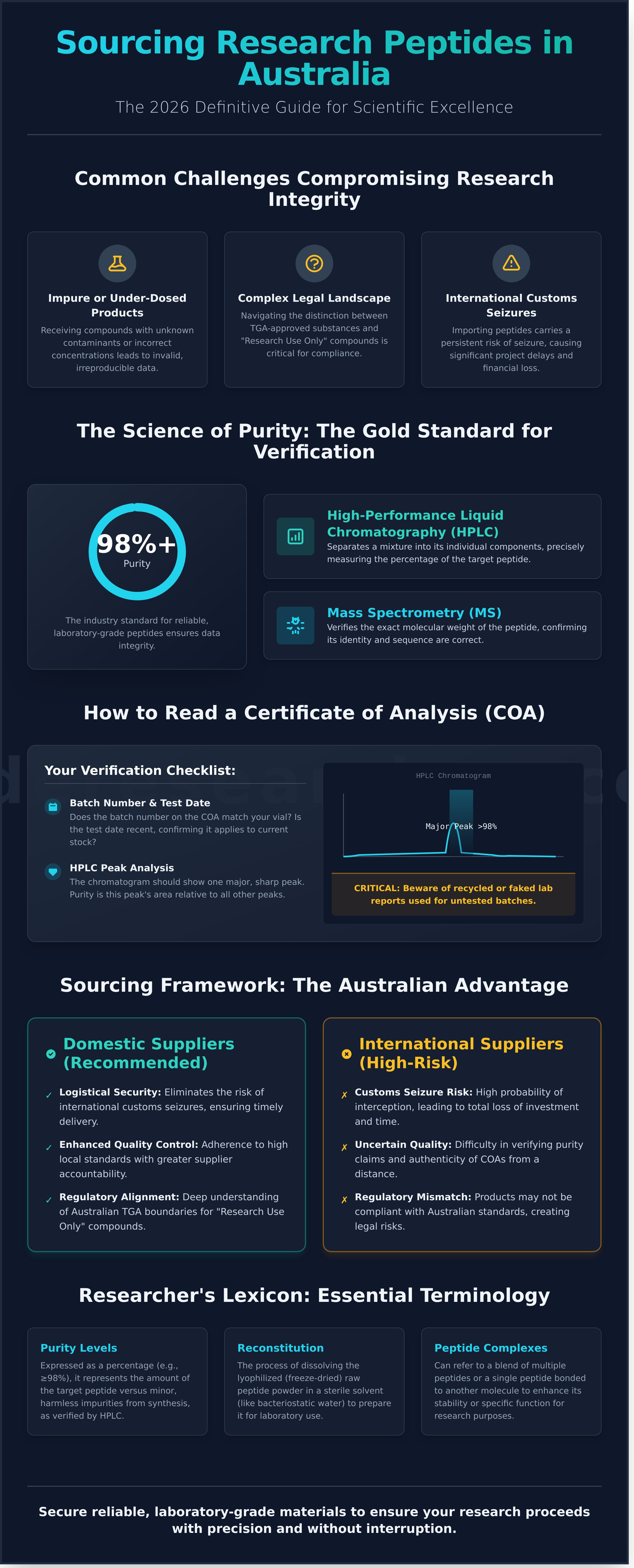
Purity Levels: Often expressed as 98% or higher, this figure represents the percentage of the target peptide sequence in the final product, as verified by High-Performance Liquid Chromatography (HPLC). The remaining percentage consists of minor, harmless impurities from the synthesis process.
Reconstitution vs. Raw Powder: Peptides are shipped as a lyophilized (freeze-dried) raw powder. "Reconstitution" is the process of dissolving this powder in a sterile solvent, such as bacteriostatic water, to prepare it for laboratory use.
Peptide Complexes: This term can refer to a blend of multiple distinct peptide compounds or a single peptide chain bonded to another molecule (like a metal ion) to enhance stability or function. This is distinct from a standard, single-sequence compound.
The Science of Purity: Evaluating Laboratory-Grade Peptides
In scientific research, reproducibility is paramount. The single most critical variable influencing the outcome of any study involving peptides is the purity of the compound itself. An impure sample containing unknown contaminants or incorrect peptide sequences will inevitably lead to unreliable and invalid data, wasting valuable time and resources. For any serious researcher sourcing peptides Australia, understanding how to verify purity is a non-negotiable skill.
The industry gold standard for assessing purity is High-Performance Liquid Chromatography (HPLC), a technique that separates a mixture into its individual components. This is complemented by Mass Spectrometry (MS), which verifies the molecular weight and confirms the identity of the peptide sequence. This rigorous analytical standard, essential in academic settings like the ongoing Monash University peptide research, should be demanded from any commercial supplier. Be vigilant for "faked" or outdated lab reports, where a single positive result is recycled for multiple, untested batches.
How to Read a Certificate of Analysis (COA)
A legitimate COA is your primary tool for verification. When reviewing the document, focus on these key data points to confirm the validity of your research-grade compounds:
Batch Number and Test Date: Ensure the batch number on the COA matches the number on your vial. The test date should be recent, confirming the analysis applies to current stock, not a batch from years ago.
HPLC Peak Analysis: The HPLC chromatogram should display one major, sharp peak representing the target peptide. The percentage purity is calculated from the area of this peak relative to the total area of all peaks. A purity level of >98% is the standard for research-grade peptides.
Testing Facility: Note whether the testing was performed in-house or by an independent, third-party laboratory. Third-party verification provides an unbiased assessment and is the hallmark of a transparent and trustworthy supplier.
Common Contaminants in Low-Quality Peptides
Purchasing non-verified peptides exposes your research to significant risks from common contaminants that compromise experimental integrity. Low-quality batches often contain:
Residual Solvents and Acids: Trifluoroacetic acid (TFA) is commonly used in peptide synthesis. If not properly removed, high residual levels can alter the pH of solutions and affect cell viability in experiments.
Bacterial Endotoxins: These are toxic byproducts of bacteria that can be present due to non-sterile manufacturing processes. Endotoxins can provoke inflammatory responses in cellular and animal models, confounding research results.
Incorrect Moisture Content: Peptides are hygroscopic (absorb moisture). Inaccurate reporting of water content means the net peptide weight is incorrect, leading to significant errors in dosage calculations and solution concentrations.
Navigating Australian Regulations and Research Standards
Understanding the legal landscape is paramount for any institution or individual conducting research with peptides in Australia. The regulatory framework is designed to separate legitimate scientific inquiry from unsanctioned therapeutic use, with several government bodies overseeing compliance. Navigating these rules ensures that research projects remain ethical, legal, and uninterrupted.
The primary distinction lies in the intended use. Peptides sold for "Research Use Only" are not classified as therapeutic goods and therefore fall outside the direct purview of the Therapeutic Goods Administration (TGA), provided they are not marketed or supplied for human consumption. However, the line is fine and strictly enforced. Any implication of therapeutic benefit can reclassify a compound, subjecting it to TGA scheduling. Furthermore, researchers in athletic fields must consider the Sport Integrity Australia (formerly ASADA) Prohibited List, as many peptides are banned substances for athletes.
Attempting to bypass these regulations by ordering from international suppliers presents significant risks. The Australian Border Force (ABF) actively screens incoming parcels for undeclared or prohibited substances, including many peptides. These shipments are frequently seized, resulting in financial loss and potential legal scrutiny for the importer.
Compliance for Laboratory and Research Facilities
For legitimate research, maintaining compliance is non-negotiable. This involves meticulous record-keeping and adherence to established protocols. Key requirements include:
Clear Documentation: Maintaining records of purchase, project scope, and institutional approval (if applicable) is essential to demonstrate legitimate research intent.
Correct Labeling: All compounds must be clearly and accurately labeled "For Research Use Only - Not for Human Consumption." This is a critical legal safeguard.
Ethical Handling: Researchers are bound by ethical standards for compound storage, handling, and disposal to ensure safety and prevent misuse.
The 2026 Regulatory Outlook for Peptides
The regulatory environment for peptides australia is dynamic, with ongoing reviews by the TGA. Compounds can be moved to Schedule 4 (S4 - Prescription Only Medicine) or Schedule 8 (S8 - Controlled Drug) if misuse becomes prevalent. The TGA enforces these classifications rigorously, and the strictness of Australian regulations for prescribing peptides has been demonstrated in cases where medical practitioners have faced disqualification. Staying informed via official TGA and Department of Health publications is crucial. Sourcing peptides from a reputable domestic supplier provides a significant layer of security, ensuring the products comply with current Australian standards and are not subject to the risks of international importation.
Sourcing Peptides in Australia: A Practical Buyer’s Framework
Acquiring research-grade peptides requires a systematic approach that prioritises purity, stability, and logistical security. Navigating the market for peptides australia involves more than just comparing prices; it demands a rigorous evaluation of the supplier and a clear understanding of handling protocols. An error in sourcing can compromise the integrity of your research before it even begins.
Opting for a domestic Australian supplier over an international one is the first critical step. International shipments face significant risks, including seizure by Australian customs, extended transit times, and potential breaks in the cold chain, which can degrade sensitive compounds. A local supplier ensures faster, more reliable delivery and adherence to Australian standards, minimising logistical variables that could impact peptide viability.
A 5-Point Supplier Vetting Checklist
Before committing to a purchase, perform due diligence using this framework to verify a supplier's credibility:
Verify 3rd-Party Testing: Insist on seeing recent, verifiable High-Performance Liquid Chromatography (HPLC) and Mass Spectrometry (MS) reports for the specific batch you intend to purchase. A reputable supplier will provide this data freely.
Confirm Australian Presence: Check for a physical Australian business address and ABN. This helps you avoid international "drop-shipping" operations masquerading as local companies, which reintroduces logistical risks.
Assess Technical Support: Contact their customer service. The staff should demonstrate a clear, scientific understanding of their products, not just sales knowledge. This is indicative of a professional, research-focused operation.
Review Shipping Protocols: Does the supplier’s shipping policy explicitly mention temperature-controlled packaging, such as insulated containers and ice packs? This is non-negotiable for maintaining peptide integrity during transit.
Examine Independent Feedback: Look beyond website testimonials. Search for feedback on independent research forums or academic communities to gauge real-world experiences with the supplier's product quality and service.
Handling and Storage Protocols for Researchers
Your responsibility for quality control begins the moment the package arrives. Simultaneously sourcing laboratory supplies like bacteriostatic water is essential, as peptides are typically shipped in a lyophilized (freeze-dried) state and require reconstitution for use.
Correct Storage Temperatures: Store lyophilized peptides in a freezer at -20°C for long-term stability. Once reconstituted with bacteriostatic water, they should be kept refrigerated at 2-8°C for short-term use as specified by the product data sheet.
Proper Reconstitution: Bacteriostatic water is the standard diluent, as its benzyl alcohol content prevents microbial growth in the vial after reconstitution, preserving the solution for multiple uses.
Gentle Handling: Peptides are fragile molecular structures. Never shake or vigorously agitate a vial to mix it. Instead, gently swirl or roll the vial between your fingers to allow the lyophilized powder to dissolve completely.
Adhering to this framework ensures that the high-purity compounds you procure are handled correctly, safeguarding the validity of your research outcomes. For a trusted source of laboratory-grade compounds that meets these stringent criteria, explore the catalog at Peptide Research AU.
Why Peptide Research AU is Your Trusted Partner for Scientific Excellence
Selecting a supplier for your research materials is a critical decision that directly impacts the validity and integrity of your work. At Peptide Research AU, we understand this responsibility and have built our operations on an unwavering commitment to quality, transparency, and the advancement of scientific discovery within Australia. Our entire process is designed to provide you with the highest calibre of compounds, backed by verifiable data and dedicated local support.
We are more than just a supplier; we are a dedicated partner in your research journey. Our commitment extends from providing consistently pure "Laboratory Grade" compounds to ensuring you have everything required for your work, including essential laboratory supplies and diluents. This comprehensive approach makes us the trusted source for leading researchers seeking reliable peptides Australia.
Our Purity and Testing Rigour
To guarantee the integrity of our products, every batch of our peptides undergoes stringent High-Performance Liquid Chromatography (HPLC) analysis, independently verified by third-party Australian laboratories. This rigorous, multi-stage protocol ensures our "Research Grade" compounds not only meet but exceed the highest global benchmarks for purity and identity. We believe in complete transparency, providing accessible testing data and Certificates of Analysis (COA) so you can proceed with absolute confidence in your materials. You can learn more about Our Purity & Testing Standards on our science page.
Supporting the Australian Research Community
Our core mission is to empower the Australian research community by providing the tools necessary to investigate innovative compounds that may lead to advancements in mental and physical wellbeing. Getting started is a straightforward process: simply identify the compound relevant to your study, review the provided technical data, and add the necessary supplies to your order for a complete research solution. We manage the logistics with fast, secure, and compliant domestic shipping to all states, allowing you to focus on what matters most-your research.
Begin your next project with a partner dedicated to scientific excellence. Explore our full range of Research Peptides and Compounds.
Advancing Australian Research with Uncompromising Quality
Navigating the evolving landscape of research peptides australia in 2026 requires a rigorous commitment to quality and compliance. As this guide has detailed, the success of any scientific endeavour is fundamentally linked to the verifiable purity of the compounds used. Understanding Australian regulations and implementing a stringent sourcing framework are critical steps for any serious researcher. These principles protect the integrity of your work and ensure your findings are built upon a reliable foundation.
At Peptide Research AU, we eliminate the uncertainty from this process. We are dedicated to empowering the scientific community by providing exclusively laboratory-grade compounds. Every batch is subject to independent, 3rd-party HPLC and Mass Spectrometry analysis, with verification readily available to you. This unwavering commitment to transparency and quality, supported by fast domestic shipping within Australia, ensures your research can proceed with confidence and precision.
Propel your studies forward with materials you can trust. Secure your high-purity research peptides from Australia’s trusted source today. Your next discovery awaits.
Frequently Asked Questions About Peptides in Australia
Are peptides legal to buy in Australia in 2026?
The legality of buying peptides in Australia depends entirely on their intended use. For legitimate in-vitro laboratory research, purchasing research-grade peptides is permissible. However, any peptide intended for human consumption or therapeutic use is classified as a prescription-only medicine (Schedule 4) by the Therapeutic Goods Administration (TGA). Possessing these without a valid prescription is unlawful. Regulations can change, so it is vital to stay informed of current TGA guidelines.
Do I need a prescription to buy research peptides online?
A prescription is not required to purchase peptides that are explicitly sold and labelled for in-vitro research and laboratory use only. These compounds are not intended for human administration. Conversely, if a peptide is for any therapeutic purpose, it is classified as a prescription-only substance in Australia. Procuring such peptides for personal use without a valid prescription from a registered medical practitioner is illegal and unsafe.
What is the difference between research-grade and pharmaceutical-grade peptides?
Research-grade peptides are synthesised for laboratory and scientific investigational use only. While they often have high purity, they are not manufactured under the sterile conditions required for human use. Pharmaceutical-grade peptides, in contrast, are produced under strict Good Manufacturing Practices (GMP). This ensures they meet the highest standards for purity, sterility, and quality control required for therapeutic administration and approval by regulatory bodies like the TGA.
How can I verify the purity of a peptide I bought in Australia?
Reputable suppliers of peptides Australia provide a Certificate of Analysis (CoA) for each product batch. This document contains crucial data from High-Performance Liquid Chromatography (HPLC) and Mass Spectrometry (MS) analyses, which verify the peptide's purity and chemical identity. Always request this documentation to ensure you are receiving a high-quality compound. For absolute confirmation, researchers can commission independent third-party laboratory testing, though this is a more complex process.
Why is bacteriostatic water necessary for peptide research?
Lyophilised (freeze-dried) peptides must be reconstituted into a liquid solution before use in experiments. Bacteriostatic water is sterile water containing 0.9% benzyl alcohol, which acts as a preservative. This agent prevents the growth of bacteria within the vial after reconstitution. Its use is critical for maintaining the sterility and integrity of the peptide solution across multiple uses, ensuring the reliability and accuracy of research outcomes.
What happens if my peptide order is seized by Australian Customs?
If an international order containing peptides is inspected by the Australian Border Force (ABF), it can be seized if it is suspected of being an unlawful import. This typically occurs if the compounds are believed to be for therapeutic use without a prescription. You would receive a seizure notice explaining the reason. To eliminate this risk, it is strongly recommended to purchase from domestic Australian suppliers, as their products do not need to clear international customs.
How long do lyophilised peptides stay stable at room temperature?
Lyophilised peptides are relatively stable and can withstand ambient temperatures for short periods, such as during domestic shipping, without significant degradation. This stability can last for several days or even weeks. However, for long-term storage to preserve maximum integrity and shelf-life, all lyophilised compounds should be stored in a freezer at approximately -20°C. Once reconstituted, they must be refrigerated and used within the recommended timeframe.
Can I use peptides for personal health or bodybuilding in Australia?
No. Research-grade peptides sold by specialised suppliers are strictly for in-vitro laboratory and scientific research purposes only. They are not produced under sterile conditions for human use and have not been approved by the TGA for safety or efficacy in humans. Using these compounds for personal health, athletic performance, or bodybuilding is a serious misuse of the product and is contrary to Australian law governing therapeutic goods.


Comments